We would never tolerate paying $16 for a gallon of milk. We would simply go elsewhere. I'll take my wallet and use my feet to go elsewhere, thank you very little.
Way too many Americans have the opposite view of government and laws. We tend to look past local and state governments and expect problems to get addressed inside the Beltway. Besides local potholes and school taxes, no problem seems too small (local) for Congress. This attitude reduces our opportunity to vote with our feet and wallet, leaving us with only one lonely ballot and a set of crossed fingers every two years.
We are simply less free when every political issue becomes federalized: we can no longer move elsewhere to escape the (over)reach of bad laws. If, for example, enough people in Maine want single payer state-run health care, they can have it at the state level. People can leave and people can move there. Businesses will come and go. An economic force is created, equal and opposite forces will react within the state of Maine. But once the same titans of finance that brought us Social Security, Medicare, and the Post Office grasp control of health care, where can we move?
Likewise, federal bailouts of profligate state legislatures punish individuals who live in fiscally responsible states by confiscating their property and transferring said property to irresponsible states. What's the point in living in Texas if you are going to be taxed twice, once for your own state budget and a second time for California's? And what's the incentive for California legislatures to get things right?
The Tea Party certainly does it part to encourage Congress to step back into its constitutional role. Expecting government to control itself from the inside, however, has its obvious limits, no matter how many Tea Party candidates breech the Beltway mote. Like any good reform, change has to begin with the public opinion of us benighted proles. This process begins by no longer expecting Congress to tackle every single issue, then encouraging fellow proles to see the light. With enough public opinion and time, the holier-than-thous in D.C. will play along.
I hope you voted today. You vote every day many times a day just by existing in a market economy. If you enjoy the options that allow you such a high and affordable standard of living, expect similar options politically. Our political standard of living really should not be any lower than economic one.
The interview covers his new book, The New Road to Serfdom: A Letter of Warning to America. Hannon is a friend of freedom with the experience and perspective of a Brit. His historical knowledge of America and limited government lend much credence to his words.
His warning is one we should heed.
Here are a few samples from the interview:
"In the mid-1990s, Republicans reintroduced Americans to an idea that had been almost totally forgotten, namely that politicians can keep their promises. "
"In all but one of these countries, people wanted spending cuts rather than tax rises. In other words, the desire for tax cuts is not peculiar to the U.S. But the belief that you can do something about it through your democratic mechanisms is a fairly unusual one."
"I had also become disillusioned with the GOP. The longer the Republicans stayed in office, the less Republican they seemed."
"Most of you [Americans] have no idea of how lucky you are."
The New York Times is curious what Tea Party folks are reading. In a recent article they report the movement has provoked a renewed interest in some classic works on freedom such as works by Hayek, Mises, and Bastiat. (Click here for full article.)
Two things in this article are striking:
1) The writer opens by emphasizing the "canon" of the Tea Party is composed of "resurrected" texts written by "dead writers" and "long-dormant ideas." (What would a Hayek or Mises zombie look like, anyway? Would they garble incoherently through Austrian accents while feasting on the flesh of bureaucrats and Keynesian professors?)
2) The not-so subtle conclusion providedfor the reader: "The works are more suited to protest than to policy making..."
Sandwiched between the opening and conclusion are tidbit samplings minus context constructed toward the quietly dismissive statement, "Neither Hayek nor Bastiat were writing with the United States in mind."
So there you go. The intellectual "fodder" of the Tea Party is founded on old, dusty texts whose authors are dead (Do ideas die, too?), who were never thinking of the United States (Really? Hayek wrote Serfdom for proponents of freedom in all free societies, specifically citing the United States several times), suitable only for the rabble-roused hoi-paloi Tea Party masses, not to be taken seriously for substantive policy changes.
If the mere age of texts and their authors is the benchmark for what is to be taken seriously, how new is socialism? Hayek and Mises came along after Marx, Lenin, and Engels. True, classical liberalism, founded on the idea of freedom, is older than socialism, the idea that societies can be planned and perfected through coercion. But if the mere age of ideas sets the bar of legitimacy we would need to re-institute human slavery: that institution predates all written history. Free societies came about much later in the time line of human ideas.
As for serious policy proposals, at the heart of classical liberalism and the economics that emanate from it is the acknowledgment that voluntary exchange between free individuals and the creative and productive capacities of free societies are responsible for lifting the masses out of hand-to-mouth existences. Conversely, attempting to plan and coerce society against the free development of its people leads to the arbitrary ordering of people's lives found in authoritarian regimes. Here you will find the miserable living standards one can expect from the denial of the dignity of the individual and his and her freedom.
Enter Hayek's Road to Serfdom. If his historical presentation is too "dusty" to be relevant, have a look-see at contemporary Cuba, North Korea, and the former Soviet Union.
Given our unsustainable debt and the ongoing growth of government intervention in our lives from everything from our incomes to our shower heads, a reinvigorated love of liberty founded on a sure intellectual footing seems very well suited for our times. It even seems like something free people would want to do for themselves, as opposed for waiting subserviently for their governing authorities to do for them.
So long live the dead guys and whatever grassroots movement that embraces liberty. The ideas they champion certainly do.
In his most recent article, Jonah Goldberg highlights the progressive vision of what the Constitution means to members of Congress and the president. That vision? Nothing.
Goldberg cites the reaction to Christine O'Donnell's insistence that she would, if elected to the U.S. Senate, support legislation only if it is constitutional. The progressive reaction is very revealing.
Posting good articles for review on a blog puts one in the uncomfortable position of adding commentary to what is essentially good commentary. (How presumptuous.) There is not much that can, or should, be added to Goldberg's piece. Nonetheless, I cannot help commenting on this quotation from a progressive "expert" on the Supreme Court, included in the article:
"How weird is that, I thought. Isn't it a court's job to determine whether or not something is, in fact, constitutional? And isn't that sort of provided for in, well, the Constitution?"
What is provided for in the Constitution is a set of clearly defined, limited legislative and executive powers in Article 1 and 2, respectively. What is also included is an oath to uphold and defend said Constitution, required of all federal and state elected and appointed officials, found in Article 6. Oh, and this little ditty is also right there in Article 6, juuuust before that whole oath to support and defend the Constitution thingy:
"This Constitution, and the Laws of the United States which shall be made in Pursuance thereof; and all Treaties made, or which shall be made, under the Authority of the United States, shall be the supreme Law of the Land..."[Emphasis weirdly added.]
Hmmmm. Let's think about this. If all elected officials (like what O'Donnell aspires to be) are required to "uphold and protect" the Constitution, by the Constitution itself, and they hold up their hands and (presumably) solemnly swear to do so as a prerequisite to holding office, how is it "weird" for a senator to, well, acknowledge she will do what her oath entails?
As Goldberg points out, the idea there is no, or should not be, constitutional limits on legislation is a new one, relatively speaking. Progressive era intellectuals introduced the idea of delimiting the power of government and its regulatory agencies in order to pursue the demands of nebulous notion of social justice. Woodrow Wilson's "New Freedom" and FDR's "New Deal" were just that, new to the American political conscious. A very big sell had to be made to Americans, what, with their historically-unique and inherent suspicion of big government with less limits on its power in their lives.
Now, for over sixty years we have been living in the not-totally-socialist-nor-completely-free society that Hayek rightly labels the "welfare state." We now see the staggering fiscal costs of having both political parties acknowledge this welfare state as the almighty epicenter of politics from which all policies emanate.
On the same hand we are young enough as a country to still recall, and hence know the virtue of, the constitutionally limited government of the Founding.
Enter the weirdness progressives and much of the public see in the idea of actually respecting the Constitution and returning it to its rightful place in legislative politics. It follows quite reasonably that, for many, using the Constitution and not the entitlement-obsessed doctrine of the welfare state as the epicenter of legislative and executive action is downright weird.
But, as in many cycles of history, what was old is suddenly new again, and what is new is viewed as weird. The Constitution is older than the progressive assault on it, so any call to bring back a constitutionally limited government, although not new, will be new (and weird) to anyone who assumes the role of government is to morph into the all-encompassing nanny state.
The Tea Party, with all its clamoring for fiscal responsibility and individual freedom, bases its arguments and hope in a return to limiting the power of the federal government. What is the most effective and principled way to do this? A return to the Constitution. Its already been there for a long time. It simply needs re-embraced.
There is nothing magical about what's in the Constitution, even though it is an extraordinary document, written and adopted out of "reflection and choice" as The Federalist Papers remind us, unlike the beginning of any other country on earth. Its primary virtue is it limits the power of the government and allows for a society in which individuals may live freely and prosper. Progressives have long rejected this notion and believe the Constitution and a respectful adherence to it is a roadblock to the social justice that can only be provide by the benevolent and unrestricted hand of government.
It is good this notion of a constitutionally-centered government is new to a lot of people and weird to others. Many, after some understandable reticence, might just show an interest in learning about the weird new thing. (Kind of like poking a dead exotic animal with a stick.) And just as important, the weirdness of it all reminds everyone how far we've drifted from the Constitution---and it forces us to make the case whether or not returning to its limited form of government is a good thing or a bad thing.
Ignoring the issue and kicking the political and fiscal can down the road would just be, well, weird.
After full experience of the insufficiency of the existing federal government, you are invited to deliberate upon a New Constitution for the United States of America….It has been frequently remarked, that it seems to have been reserved to the people of this country to decide, by their conduct and example, the important question, whether societies of men are really capable or not, of establishing good government from reflection and choice, or whether they are forever destine to depend, for heir political constitutions, on accident and force. [Emphasis Added] From Federalist 1
Hamilton's above remarks were addressed to the people of the state of New York during the period of the ratification debates, after the Constitutional Convention and before the people of each state voted for or against adopting the novel Constitution.
And novel it was. For the first time in its history a segment of mankind convened, deliberated, debated, and formed a charter of government that set the governing parameters of the central government. It was the result of reflection, rationally derived from the minds of men who knew history, human nature, and politics.
There were prefiguring constitutions such as the Mayflower Compact, the Fundamental Orders of Connecticut, and the founding charters of the original colonial governments. These documents were original in their own right, but there were elements of "force and accident" that necessitated their creation. The Articles of Confederation, for example, were hurriedly drawn and implemented in the face of the Revolutionary War.
What set the Constitution apart was its deliberate and planned conception, its scope and ingenuity, and its intent to properly limit the powers of central government to protect the liberties of the people while affording said government the requisite power to maintain stability and avoid the suicidal tendencies of the few examples of popular governments (democracies, that is) history had to afford.
Equally novel was the manner in which the Constitution was to become the supreme law of the land: It was accepted by choice. Ratification conventions were drawn among the several states with the sole purpose of voting up or voting down the proposed Constitution. By design of the Constitution itself, such conventions were to be composed of the people themselves; state legislatures were not allowed the authority to vote for or against the Constitution. Hence, the people of the respective states voted, not the states themselves. (This is an important distinction as it further solidified the popular character and beginnings of the Constitution, and supported Madison's contention that the new government was a federal one, neither wholly national nor merely another compact of states. It was partly national, partly a government of respective states. See Federalist 39)
The Constitution was also a boldly liberal document, liberal in the classical sense and in the broadly novel approach it took to difficult issues. The words, "slavery," or "slaves" do not appear anywhere, yet it deals directly with the issue by severely limiting the voting power of the slave holding districts by reducing their representation in the House by 3/5. This, contrary to contemporary misgivings, was a great step forward as it diminished the number of pro-slavery votes in legislation.
And who was barred from voting for representatives in the House? Put another way, who was permitted, in the Constitution, to vote for members of the House? If you said, "White property holding males" go to the back of the class: No one was denied! The qualifications were left to the state legislature to decide. This left the possibility completely open to wider suffrage. This is a striking historical step forward when considering the broader historical and world context (it was 1789) and the state of equal rights, minority rights, and free society.
Looking at our constitutional history, it is good to remember its unique origin, implementation, and unique features. What is equally important is to take a step back and consider how far we have departed from the constitutional government under which we are supposed to live freely. We need to ask ourselves, is it time we once again "reflect" upon our situation and bring about a constitutional change through"choice"?
The grassroots stirrings of the past year and a half indicate there is a lot of attention placed on the state of our government, economy, debt, and freedoms. Many more people are turning an eye to our situation and to our future. Happily, there is a lot of reflecting taking place as numerous educational groups are once again reading our history and studying the Constitution (Yay! Imagine that.) The connection of individual liberty to constitutionally limited government is a concept that is spreading, again. A significant number of Americans have made a good choice, and this is a very good thing.
Who, then, is left to reflect and choose, once again, the Constitution and embrace and respect its authority as the charter by which government is to conduct itself?
That would be the ensconsed powers-that-be in both political parties. They can be made to "reflect" upon the virtue of following the Constitution, that reflection being the consideration of their likelihood to lose their offices come election time. Here is the choice to be reflected: "If I disregard limited constitutional government, I don't get reelected."
And election time includes the primaries.
The more upward pressure from the grassroots level, the more likely politicians will again choose the Constitution. If we're frank with ourselves, we'll acknowledge that history teaches the Constitution is incapable of enforcing itself and the politicians that swear to uphold and protect it will discard and destroy it when we let them off of their electoral leash.
As a culture we are learning and relearning our Constitution. Now we are turning the hard work of teaching it to our politicians. They've become too much like poor old Barney Fife:




 for proponents of freedom in all free societies, specifically citing the United States several times), suitable only for the rabble-roused hoi-paloi Tea Party masses, not to be taken seriously for substantive policy changes.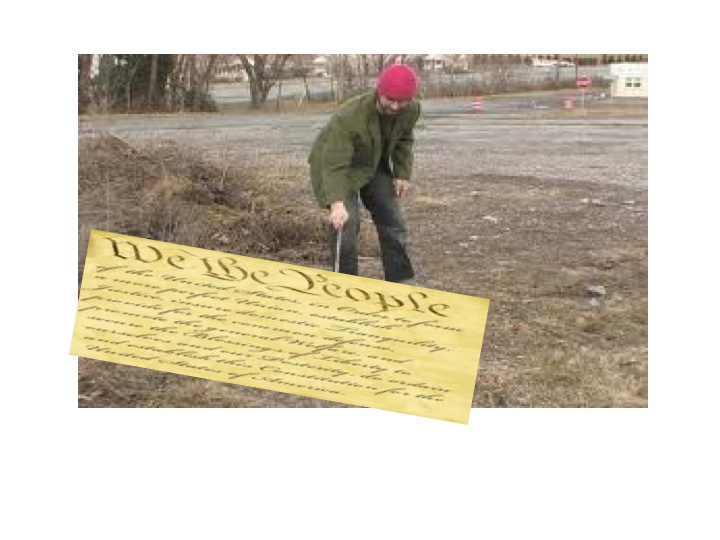
 remind us, unlike the beginning of any other country on earth. Its primary virtue is it limits the power of the government and allows for a society in which individuals may live freely and prosper. Progressives have long rejected this notion and believe the Constitution and a respectful adherence to it is a roadblock to the social justice that can only be provide by the benevolent and unrestricted hand of government.